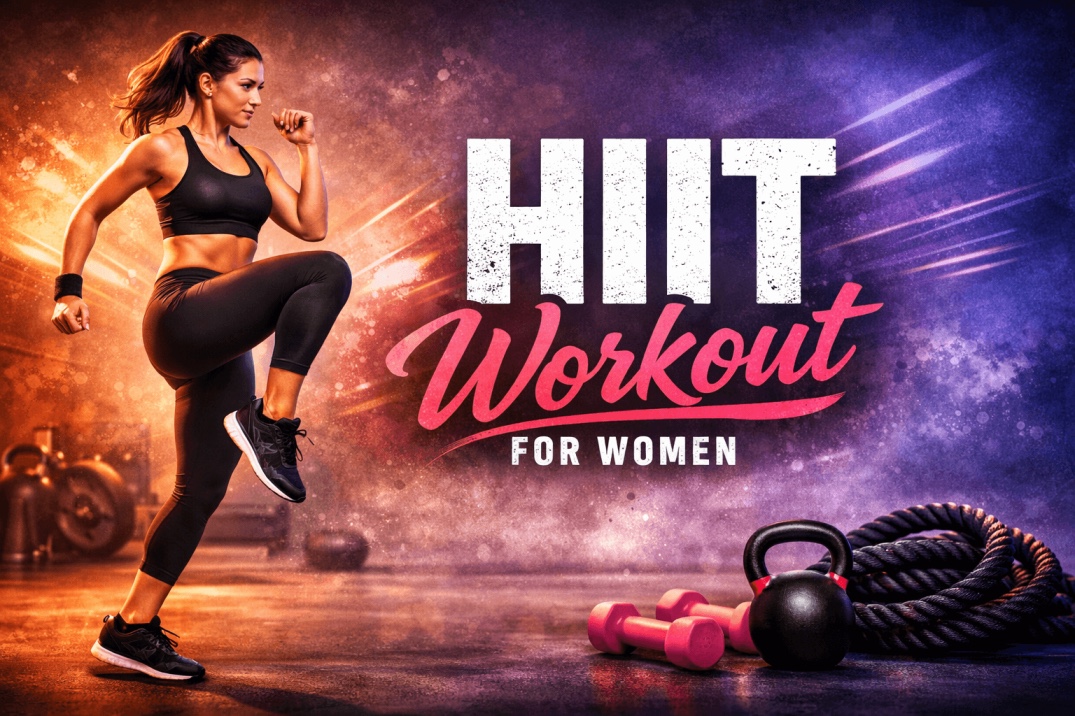
A HIIT workout for women is one of the fastest ways to get fitter without spending hours exercising. HIIT (High-Intensity Interval Training) uses short bursts of effort followed by quick recovery breaks. The result is a workout that feels intense, saves time, and works your whole body.
The best part is you can do HIIT in a way that suits your body and lifestyle. You can keep it low-impact if you’re protecting your knees, focus more on glutes and core if that’s your goal, or keep it simple if you’re restarting after a long break. With the right routine, HIIT can help you feel stronger, lighter, and more energetic in daily life.
Why HIIT Works So Well for Women
A well-planned HIIT workout for women supports both cardio fitness and strength, which is exactly what most women want from a home routine.
Key benefits women usually notice
- Fat loss support (with consistency): HIIT keeps your heart rate up and burns calories efficiently.
- Toning and strength: Squats, lunges, and planks help build legs, glutes, and core strength.
- Better stamina: You’ll feel less tired during walking, stairs, and day-to-day work.
- Time-friendly: 15 to 25 minutes is enough for a complete session.
- Flexible intensity: You can do low-impact HIIT and still feel the burn.
HIIT is not “one style fits all”
Women respond best when HIIT is adjusted based on:
- Current fitness level (beginner vs regular training)
- Joint comfort (knees, ankles, lower back)
- Energy levels and recovery
- Life stage (postpartum, perimenopause/menopause, PCOS goals, etc.)
Safety and Comfort Checklist (Important for Women)
Before starting any HIIT workout for women, this quick checklist helps you train safely and avoid common issues.
Warm-up is non-negotiable
A 3 to 6 minute warm-up reduces knee and ankle stress and helps your workout feel smoother.
Choose the right intensity
HIIT should feel challenging, but you should still be in control. If your form breaks, reduce speed, switch to low-impact, or extend rest time.
Be careful in these situations
- Pregnancy or postpartum recovery: Choose low-impact moves and get professional guidance if needed.
- Pelvic floor weakness or leaking during jumping: Skip jumping. Use step-based cardio instead.
- Knee pain: Avoid repeated jumping and deep lunges. Use squats to a chair and step-back taps.
- Lower back pain: Keep core braced and avoid fast twisting moves.
Stop immediately if you feel
Dizziness, sharp pain, chest discomfort, or unusual shortness of breath.
Warm-Up for Women (4 to 6 Minutes)
Before any HIIT workout for women, this warm-up helps protect your knees, ankles, hips, and lower back. It also makes the workout feel easier and more controlled.
Do 1 round:
- March in place with arm swings – 45 sec
- Shoulder rolls + arm circles – 30 sec
- Hip circles – 30 sec
- Glute activation (standing kick-backs) – 45 sec
- Slow bodyweight squats – 45 sec
- Step jacks (no jumping) – 45 sec
- Alternating reverse step-backs – 45 sec
If you feel stiff, repeat the warm-up once more.
Best HIIT Timer Formats for Women (Pick One)
Choose a format that matches your current fitness level. You’ll get better results by being consistent, not by going too hard on day one.
Beginner
- 20 sec work / 40 sec rest
- Total: 10–15 min
Best for: beginners, restarting after a break, low stamina
Intermediate
- 30 sec work / 30 sec rest
- Total: 15–20 min
Best for: regular exercisers
Advanced
- 40 sec work / 20 sec rest
- Total: 20–25 min
Best for: consistent training, good recovery
Tip for comfort: If jumping feels uncomfortable (knees or pelvic floor), use step-based cardio. You can still keep intensity high without impact.
20-Min HIIT Workout for Women (No Equipment, Home-Friendly)
This routine is designed to support fat burn and full-body toning, with extra focus on glutes and core.
Format: 40 sec work / 20 sec rest
Rounds: 2 rounds
Total: 20 minutes (10 exercises per round)
Round (Repeat Twice)
- Squat to Chair Tap
Sit back, lightly tap a chair/sofa edge, stand up strong.
Low-impact by default. - Step Jacks
Step side-to-side while lifting arms overhead.
Pelvic-floor friendly cardio. - Reverse Lunges (or Step-Back Taps)
Controlled step back, push through front heel. - Incline Push-Ups (Sofa/Wall)
Keep body straight, move slow and steady. - Mountain Climbers (Slow and Controlled)
Core tight, hips steady.
Go slower to protect wrists and back. - Glute Bridges
Squeeze glutes at the top, don’t over-arch the lower back. - Skaters (Step Version)
Step side-to-side with a small bend in knees.
No jumping needed. - Plank Shoulder Taps (Knees Down if Needed)
Tap opposite shoulder without swaying hips. - Dead Bug (Core Control)
Keep lower back gently pressed down, move slowly. - Squat + Calf Raise
Squat, then rise up onto toes to finish strong.
Between rounds: Rest 60–90 seconds, sip water, then repeat.
Quick Cool-Down (2 Minutes)
- Slow walk in place – 45 sec
- Quad stretch – 30 sec each side
- Chest/shoulder stretch – 15 sec
Section 7: Weekly HIIT Plan for Women (Simple and Sustainable)
For most women, the best results come from doing a HIIT workout for women consistently, without overtraining. Use this weekly structure based on your level.
Beginner (Weeks 1–2)
- 3 HIIT sessions per week
- 2 days light walking or stretching
- 2 rest days
Intermediate (Weeks 3–6)
- 3 to 4 HIIT sessions per week
- 1 to 2 days walking or mobility
- 1 to 2 rest days
Sample Weekly Schedule (Easy to Follow)
- Monday: 20-min HIIT
- Tuesday: Walk 25–40 min + light stretching
- Wednesday: 20-min HIIT
- Thursday: Mobility or yoga (10–15 min)
- Friday: 20-min HIIT
- Saturday: Walk or light activity
- Sunday: Rest
If you feel overly sore or tired, swap one HIIT day for a walk. Consistency is more important than pushing hard.
How to Progress Your HIIT Workout (Women-Friendly Progression)
Progress should feel steady, not exhausting. Use this simple approach:
Week-by-week progression
- Week 1: 1 round (10 minutes) + build comfort with moves
- Week 2: 2 rounds (20 minutes)
- Week 3: Keep 2 rounds but reduce rest slightly (20 sec to 15 sec once ready)
- Week 4: Increase effort during work intervals (move faster, stay controlled)
Safe ways to level up (without jumping)
- Squat to chair tap → deeper squat (same control)
- Incline push-up → lower incline → floor push-up
- Step jacks → faster steps and bigger arm range
- Slow climbers → quicker climbers while keeping hips stable
- Add one extra round only if recovery feels good
Good sign: your breathing settles within a few minutes after finishing, and you feel energised later, not drained.
Common Mistakes Women Make in HIIT (And How to Fix Them)
1) Skipping warm-up
Fix: Always do 4 to 6 minutes. It protects knees, hips, and ankles.
2) Jumping too early
Fix: Use step-based cardio first. You can get intensity without impact.
3) Ignoring pelvic floor signals
If you notice leaking, heaviness, or discomfort during jumps, your body is asking for a change.
Fix: Remove jumping moves and use low-impact swaps.
4) Going too hard too soon
Fix: Start at 7/10 effort. Build over 2–3 weeks.
5) Doing HIIT every day
Fix: Keep HIIT to 3–4 days per week. Add walks and mobility instead.
6) Poor squat and lunge form
Fix: Slow down. Knees track over toes, chest up, push through heels.
Low-Impact Swaps (Joint and Pelvic-Floor Friendly)
This HIIT workout for women can be made low-impact without losing intensity. If you have knee discomfort, are postpartum, feel pelvic-floor heaviness, or simply prefer no jumping, use these swaps.
Easy swaps you can follow instantly
- High knees → Fast march with strong arm swings
- Jumping jacks → Step jacks
- Skaters (jumping) → Side step skaters (no jump)
- Burpees → Walk-back burpees
- Mountain climbers (fast) → Slow controlled climbers
- Jump squats → Regular squats or squat-to-chair taps
- Plank jacks → Plank step-outs
- Reverse lunges (deep) → Step-back taps
Tip: Keep your effort high by moving faster, increasing range slightly, or adding a round once you feel stable.
Recovery Tips for Women (So You Don’t Burn Out)
Recovery is where your body adapts. If you want consistent results from a HIIT workout for women, make recovery part of the plan.
The simple recovery checklist
- Leave one full rest day per week if you do HIIT 3–4 times
- Walk on non-HIIT days (20–40 minutes is enough)
- Stretch for 3–5 minutes after each session
- Prioritise sleep because poor sleep affects energy, cravings, and recovery
- Hydrate well especially if you sweat a lot
- If you feel unusually tired, reduce HIIT frequency for a week instead of quitting fully
Quick post-workout meal idea (simple and realistic)
Within 60–90 minutes, try to include:
- A protein source (eggs, dal, paneer, chicken, tofu)
- A carb source (rice, roti, oats, fruit)
- Some fibre (vegetables, salad)
This helps recovery and supports strength and tone goals.
FAQs (HIIT Workout for Women)
Is HIIT good for women who want fat loss?
Yes. HIIT can support fat loss by improving fitness and helping you stay consistent. Best results come when you pair HIIT with regular movement, good sleep, and balanced eating.
Can women do HIIT during periods?
Many women can, but energy and comfort vary. If cramps or fatigue are high, choose low-impact HIIT, reduce rounds, or switch to walking and stretching.
Is HIIT safe postpartum?
Postpartum bodies need gradual rebuilding. Low-impact, step-based HIIT is often safer than jumping. If you have pelvic-floor symptoms (leaking, heaviness), avoid impact and consider professional guidance.
Can HIIT help tone legs and glutes?
Yes. Squats, lunges, bridges, and step-based cardio work legs and glutes well. Consistency matters more than doing high-impact moves.
How many days a week should women do HIIT?
Most women do best with 3 to 4 sessions per week, with walking or mobility on other days.
Do I need equipment for HIIT at home?
No. Bodyweight HIIT is enough to start. A mat and a timer are helpful but optional.

.jpg)

.webp)